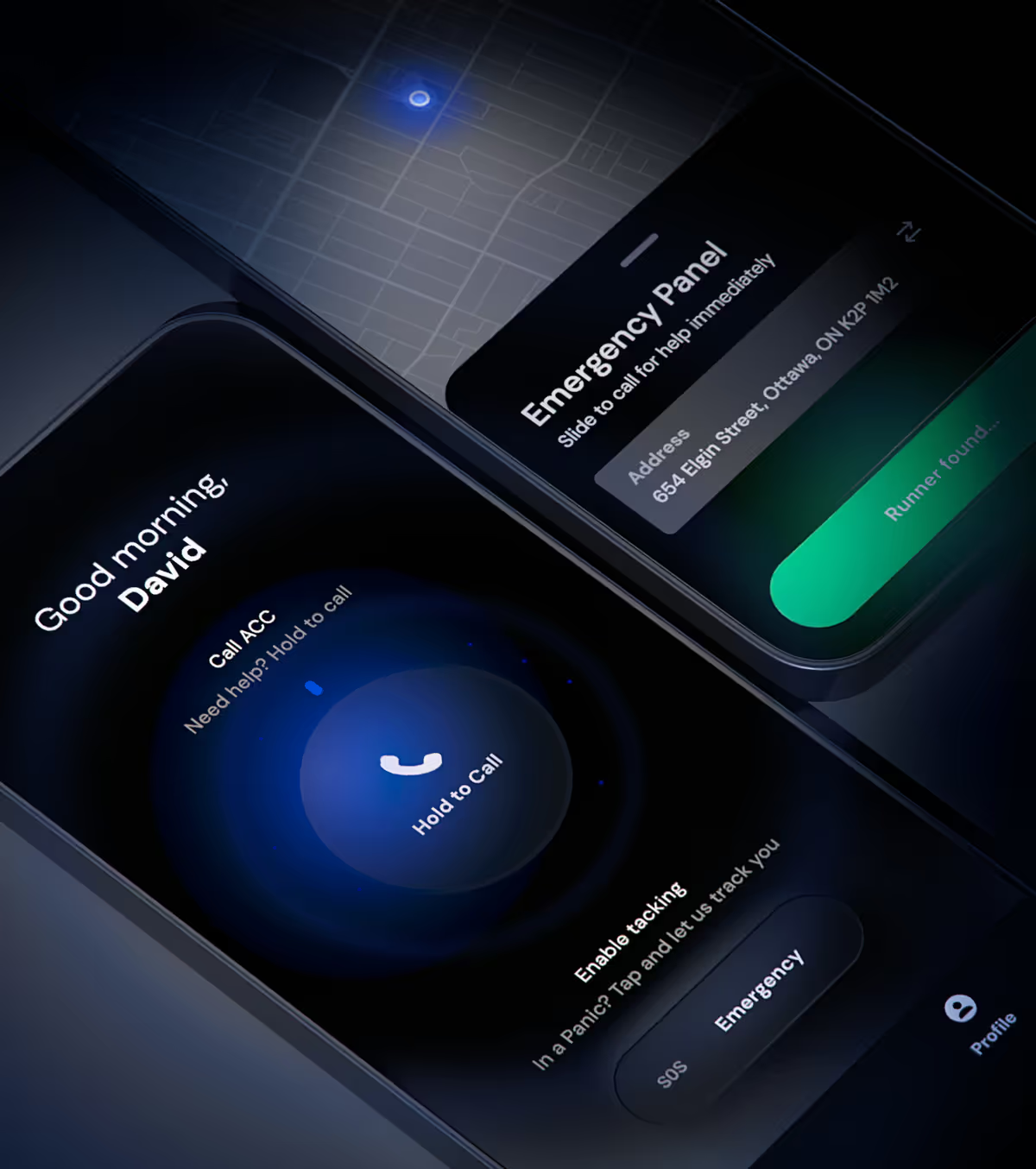
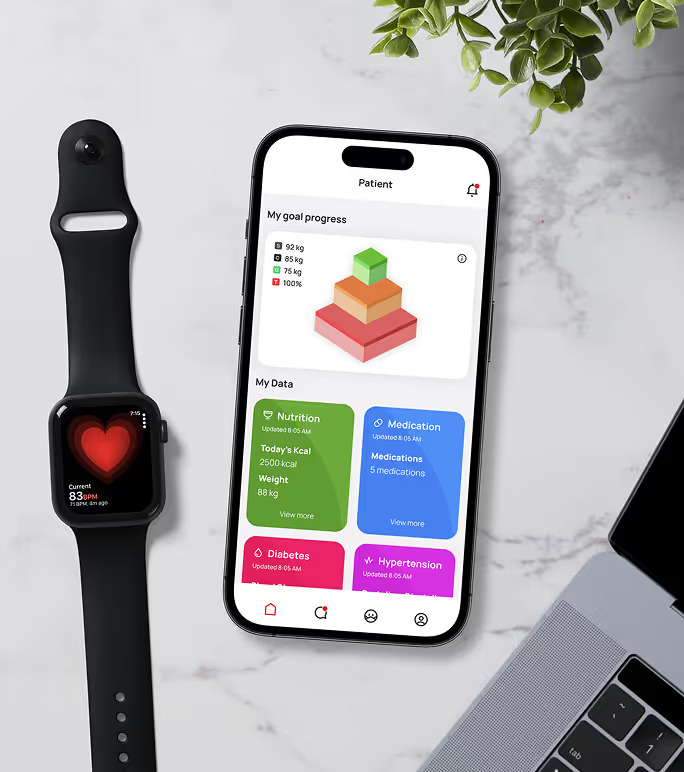
Did YOU make this or... AI?
I’ve heard this question more times than I can count — sometimes with curiosity, often with suspicion. As if the answer determines whether the work deserves respect.
The question is wrong. Not because it doesn’t matter, but because it assumes a binary that no longer exists.
The real question is not whether AI was involved.
The real question is whether the human was.
No, AI didn’t make this. I made this with AI.
That distinction is everything.
The Disclosure penalty
There is a strange social dynamic at play: admit you used AI, and people mentally subtract points.
The work becomes less than.
Less impressive.
Less worthy of praise.
Less yours.
But say, “I crafted this pixel by pixel in Photoshop,” and people nod. They respect the labor. They imagine you hunched over a screen, painstakingly adjusting curves and masks. That image feels like craft to them.
Same output.
Different story.
Different perception.
Nobody ever asked, “Did you make this or did Photoshop?” Nobody questioned whether Figma deserved credit for your interface. Those are tools. AI is a tool too.
But because it feels like it has agency — it responds, it generates, it surprises — we project authorship onto it in a way we never did with static tools.
I hear it often from people who spent years mastering their craft:
“No, you didn’t make this. AI made it. You just told AI what to do.”
As if prompting is trivial.
As if direction is nothing.
But here’s what they don’t see: you can spend an entire day wrestling with output. Changing direction. Refining. Rejecting. You have to imagine the thing first — in your head — before you can pull it out through AI. You have to hold the experience, the constraints, and the logic together before a single line gets generated.
That’s not “just telling AI what to do.”
That’s the work.
Why slop happens
People assume AI requires minimum effort.
So they put in minimum effort.
They prompt a couple of times, accept the initial outputs, and ship it.
The result is slop — generic, soulless, indistinguishable from a million other things made the same way.
And when the world sees that slop, it confirms the bias:
“See? AI makes bad work.”
But slop is not an AI problem.
Slop is a human problem.
The same technology that produces forgettable garbage can produce exceptional work.
The variable is not the tool.
The variable is who’s holding it.
Should I feel bad about it?
A question I still ask myself:
Should I feel bad that I’m building with AI?
I feel it sometimes — a strange guilt. Because I’ve realized that I can create things that are beautiful and functional without first drawing pixels. Without the rituals I spent years perfecting.
It feels like cheating.
Until I realize: my superpowers didn’t disappear.
They’re supercharging the new way of building.
Everything I learned — composition, flow, instinct — feeds directly into how I direct the AI.
The craft didn’t die.
It evolved.
Craft was never about the specific motions of your hands.
It was about the quality of your decisions.
And those decisions still matter — maybe more than ever.
The ownership trap
The moment you accept that what you’ve built is AI’s and not yours, you stop caring.
You disengage.
You become a passenger.
Why fight for that extra 10% when it’s not really your work anyway?
“AI made this” vs. “I made this with AI” sounds like semantics.
It isn’t.
The first framing turns you into a dispatcher.
The second keeps you in the driver’s seat.
And drivers care about where they’re going.
AI is a tool.
Powerful.
Sometimes startling.
But tools don’t own the work.
The person holding them does.
Where craft lives now
Craft has “migrated”.
It used to live in Photoshop panels and Figma canvases.
Now it lives in many different places, in a back-and-forth battle inside Canvases, Figma Makes and IDEs.
In prompts.
It lives, in the back-and-forth of a conversation with a reasoning model. The people who will thrive with AI are not just those who use it. They’re the ones who understand the medium they’re working in.
If you want to craft with AI, learn where craft lives now.
The Client Question
A client pays you to build something.
A platform.
A website.
An app.
The classic way:
Design in Figma.
Present.
Iterate.
Hand off.
Two weeks minimum for the design phase alone.
But what if it was made in Figma Make?
Or built directly in Cursor & Figma MCP?
This year I’ve realized something uncomfortable:
When you can build the real thing as fast as you can fake it, why fake it?
So you go back to the client and say:
“In the time I would normally need to design this, I’ve built a working prototype. Interactive. Real code. Ready to evolve into production.”
Should the client ask for their money back?
Should they say:
“Oh, you made it with AI? I could make this too.”
No.
You couldn’t.
Because you don’t have the years of instinct that shaped every decision.
Because you don’t know which outputs to reject.
Because you don’t know which details matter.
The work isn’t in the generation.
It’s in the curation.
The client paid for an outcome.
They got a better one, faster.
The tool changed.
The value didn’t.
Enough is enough.
Stop asking:
“Did you make this, or was this AI?”
Start asking:
“Is the maker visible in the work?”
Because that’s what matters.
Not the tool.
Not the process.
Not the story you tell about how hard it was.
The presence of a human who cared enough to shape something with intention.
AI can generate.
But it can’t care.
And care is still the rarest ingredient in good work.
I made this with AI.
The AI did the labor.
I did the craft.
.jpg)